

UBOs and PEPs
We provide this translation for your convenience. If the versions differ, the Dutch text takes precedence. Read the Dutch page (updated on 21 November 2026). About this translation.
For a Dutch private limited company, look at ownership and control to identify the ultimate beneficial owner (UBO). To establish whether someone is a politically exposed person (PEP), check whether they hold or have held a prominent public function. Under Articles 3 and 8 of the Wwft, you must identify the UBOs and check whether PEP measures apply to the customer or a UBO. These measures also apply if the customer or a UBO falls within the statutory definition of a PEP’s family member or is known to be a close associate of a PEP.
Who is the ultimate beneficial owner?
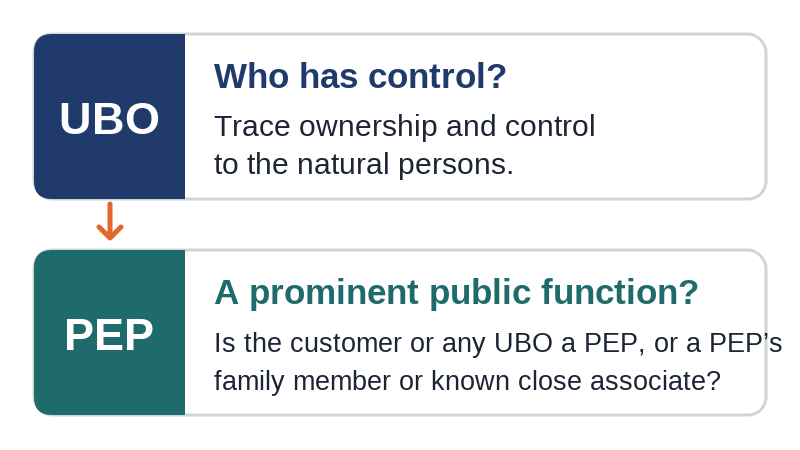
UBO stands for ultimate beneficial owner. For a business customer, establish which natural persons ultimately own or control the business. Article 3 of the Wwft Implementation Decree 2018 sets out the criteria for each legal form. If there is an intermediate holding company, see how to trace the ownership chain.
Which criteria apply to each legal form?
| Legal form | Who do you check? |
|---|---|
| Unlisted BV or NV | Among other things, check who directly or indirectly holds more than 25% of the shares, voting rights or ownership interest. Also check who exercises control via other means. |
| Other legal person or partnership | Apply the criteria for that legal form. For example, see how to identify the UBO of a Dutch foundation or association. |
| Trust | Check the settlors, trustees, any protectors, the beneficiaries or class of beneficiaries, and anyone else who exercises ultimate control. The 25% threshold does not apply to these roles. |
How do you substantiate your findings?
- Map the structure Trace shareholdings, voting rights and control arrangements to the natural persons who ultimately hold those rights or exercise control.
- Verify identity Identify each UBO. Take reasonable measures to verify their identity and record which documents you rely on.
- Check registration When you enter into a business relationship with an entity that must register, obtain proof of registration and check that its UBOs are registered. If you do not have direct access to the UBO register, ask the customer for a certified extract. Use it as part of your own due diligence.
When might a pseudo-UBO be relevant?
The Dutch fallback rule applies only to eligible entities and only if there are no grounds for suspicion. Once you have exhausted all possible means, senior managing officials may qualify as pseudo-UBOs if you still cannot identify a UBO or still doubt whether the person you identified is the UBO. In a Dutch private limited company, these are the statutory directors. In a Dutch limited partnership, they are the general partners.
When do PEP measures apply?
Check whether your customer or a UBO holds or has held a prominent public function. Such a function can carry a particular risk of corruption. PEP status alone does not indicate a criminal offence.
Which roles qualify?
- Head of state, head of government, minister, deputy minister or state secretary.
- Member of parliament or of a similar legislative body, or member of the governing body of a political party.
- Member of a high-level judicial body whose decisions are generally not subject to further appeal.
- Member of a court of auditors or of the board of a central bank.
- Ambassador, chargé d’affaires or high-ranking officer in the armed forces.
- Member of the management, supervisory or administrative body of a state-owned enterprise.
- Director, deputy director, board member or someone holding an equivalent role in an international organisation.
Which people connected to a PEP do you check?
The same special measures apply if your customer or a UBO has one of the following ties to a PEP.
- Family. The PEP’s spouse or equivalent partner, the PEP’s parents and children, and each child’s spouse or equivalent partner. An equivalent partner is someone the law treats as a spouse.
- Business ties. Someone who is a UBO of the same entity or arrangement as the PEP, has another close business relationship with the PEP, or is the sole UBO of an entity or arrangement that was in fact set up for the PEP’s benefit.
What to do during and after the term of office
Obtain approval from senior management to enter into or continue the business relationship or to carry out the transaction. Take appropriate measures to establish the source of wealth and the source of the funds used. Carry out enhanced ongoing monitoring of the business relationship.
For at least twelve months after the person leaves office, take account of the risk associated with their former role. Keep appropriate measures in place for as long as that risk persists. Use the PEP check to record your assessment and the PEP declaration to request the information from the customer.
Unsure whose interest exceeds 25%? Check the figures with the UBO calculator. You can use a UBO declaration to request the information from the customer. The white paper on UBO checks (Dutch) takes you through the process from the declaration to recording your decision in the customer file.
FAQs
What is the difference between a UBO and a PEP?
To identify a UBO, look at who ultimately owns or controls the customer. A PEP is someone who holds or has held a prominent public function. The same person can be both.
Whose PEP status must I check?
Check whether the customer or a UBO holds or has held a prominent public function, for example as a minister, member of parliament or ambassador.
Do PEP measures also apply to family members?
Yes. The special measures also apply if, for example, your customer or a UBO is the PEP’s partner, parent or child. The same applies to people known to be close associates of a PEP, such as someone who is a UBO of the same business as the PEP.
For general information only. This does not constitute legal advice. Consult the current regulations or a qualified adviser about your situation. Spotted an error? Let the editors know.
Customer Diligence is a knowledge base on the Wwft, powered by RiskResolve. It does not provide legal advice.
About · Editorial team and methods · Contact · Privacy · Terms of use · RiskResolve software · UK rules · About this translation
Sources for every article