

Does the Wwft apply to you?
We provide this translation for your convenience. If the versions differ, the Dutch text takes precedence. Read the Dutch page (updated on 21 November 2026). About this translation.
You are subject to the Wwft if your organisation or professional activity falls within one of the categories in Article 1a. For each engagement, identify the service you provide and check whether a threshold or exemption applies. If you act as an intermediary in a property purchase, for example, the Wwft applies whatever the purchase price. If you act as an intermediary in a letting, it applies when the monthly rent is €10,000 or more.
How do you assess an engagement?
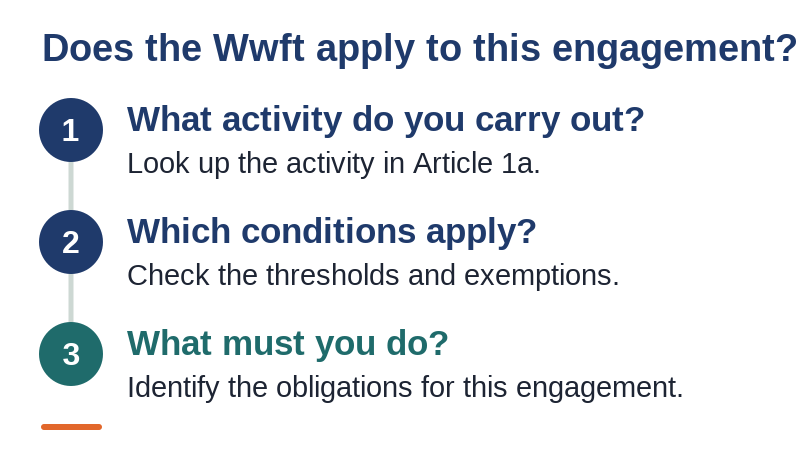
- Describe the work Are you selling on your own account, acting as an intermediary for someone else or giving advice? Record what the customer has asked you to do.
- Find the activity Compare the engagement with the activities listed in Article 1a of the Wwft. Check the thresholds, exemptions and any sector-specific rules.
- Decide what to do next Check whether customer due diligence, the reporting obligation or the ban on cash payments applies. The Wwft check can help you find your activity.
Banks
For banks, Article 1a(2) draws on the Dutch Financial Supervision Act. It also sets out the exemptions and explains how the rules apply to Dutch branches of foreign banks.
Other financial undertakings
Article 1a(3) lists the following groups, among others. Check the statutory definition for your business.
- Businesses that mainly carry out certain banking activities or provide payment services, and payment service agents.
- Investment firms, alternative investment funds and undertakings for collective investment in transferable securities (UCITS).
- Electronic money institutions, exchange institutions and crypto-asset service providers.
- Life insurers and life insurance intermediaries. An exemption applies to insurers that offer only funeral insurance with benefits in kind.
Which professional activities does the Wwft cover?
These examples will help you find the relevant provision. Article 1a also lists other activities, such as renting out safe deposit boxes, subject to the conditions set out in the Act.
| Activity | What determines the scope? |
|---|---|
| Tax advice and accountancy | Tax advice you provide independently and on your own account, external accountancy services and comparable work specified in the Act. |
| Trust and domiciliation services | Special rules apply to trust offices. Providing an address or postal address on a professional basis may also fall within the scope of the Wwft. |
| Property brokerage | The Wwft covers intermediaries in property purchases and sales. For lettings, it applies where the monthly rent is €10,000 or more. |
| Property valuation | Property valuers must report unusual transactions when carrying out valuations. Article 3 does not require them to carry out customer due diligence for this activity. |
| Art dealing and storage | For professional buyers and sellers of works of art, the threshold is a payment of €10,000 or more. Add together the amounts of linked transactions. Under Dutch law, storing works of art in a free port does not in itself give rise to a separate obligation. Read the guidance for the art trade. |
| Brokering transactions in goods | The Wwft covers intermediaries who arrange the purchase or sale of vehicles, ships, works of art, antiques, precious stones, precious metals, jewellery or jewels. |
| Gambling and pawnbroking | The Wwft covers casinos and remote gambling operators, among others. Pawnbrokers must still carry out customer due diligence and report unusual transactions when they lend against goods. |
What rules apply to cash payments for goods?
When does the Wwft apply to work by lawyers and civil-law notaries?
Article 1a(4) describes the work of lawyers, civil-law notaries, junior notaries, assigned notaries and comparable legal service providers. Examples include giving independent advice or assistance with the following activities.
- Buying or selling property subject to registration, or creating a mortgage over it.
- Managing money, securities, precious metals, precious stones or other assets.
- Forming or managing a company, partnership or legal person, or arranging the contributions needed to do so.
- Buying, selling or taking over a shareholding or a business, in whole or in part.
- Carrying out tax work comparable to that of a tax adviser.
The Wwft may also apply if you act in a customer’s name and on their behalf in a financial or real estate transaction. Under Article 1a(5), the exemption covers, among other things, ascertaining a customer’s legal position and providing assistance in connection with legal proceedings. If the engagement changes, reassess the new work.
Sources
- Wwft, Articles 1a, 1f, 3 and 16 — Dutch legislature, text as at 1 July 2026.
- Dutch ban on cash payments of €3,000 or more — Government of the Netherlands, accessed 21 November 2026.
- Explanatory memorandum, section 7.2 on art in free ports — Dutch Minister of Finance, 2019.
- Estate agents and the monthly rent threshold — FIU-Nederland.
Do you work in a small team? The white paper on organising Wwft compliance in a small firm (Dutch) explains how to set policy, allocate tasks and organise customer files when you have only a few people.
For general information only. This does not constitute legal advice. Consult the current regulations or a qualified adviser about your situation. Spotted an error? Let the editors know.
Customer Diligence is a knowledge base on the Wwft, powered by RiskResolve. It does not provide legal advice.
About · Editorial team and methods · Contact · Privacy · Terms of use · RiskResolve software · UK rules · About this translation
Sources for every article