

Reporting unusual transactions
We provide this translation for your convenience. If the versions differ, the Dutch text takes precedence. Read the Dutch page (updated on 21 November 2026). About this translation.
Article 16 of the Wwft covers both completed and intended transactions. Once you know that a transaction is unusual under an indicator for your profession, you must report it without delay to FIU-Nederland. This also applies to a payment you learn about while providing your services, for example when checking a customer’s accounts. Record the facts that prompted the report. Do not disclose the report or its existence to the customer.
Which activities do you assess?
This covers a single act or a series of linked acts by or for a customer, provided you become aware of the act or acts in the course of providing your services. If you are an accountant, this can include a payment you find in a customer’s records.
When is a transaction unusual?
| Indicator | When to report |
|---|---|
| Objective | The transaction meets a criterion for your profession. You must report it even if the customer gives a plausible explanation. |
| Subjective | The facts give you reason to believe that the transaction may be linked to money laundering or terrorist financing. |
Four examples for banks
- Exchanging €10,000 or more in cash, either by changing one currency into another or by exchanging low-denomination notes for high-denomination notes.
- Making a cash deposit of €10,000 or more to be credited to a credit card or prepaid card.
- Using a credit card or prepaid card for a transaction of €15,000 or more.
- A money remittance of €2,000 or more, unless the institution entrusts settlement to another institution that is also subject to Article 16(1) of the Wwft.
The indicators vary by profession. Consult the annex to the Wwft Implementation Decree 2018 (Uitvoeringsbesluit Wwft 2018) and FIU-Nederland’s reporting indicators for banks.
Which facts are decisive?
A payment that departs from the usual pattern may raise suspicion. Consider whether the payment fits the customer’s activities. Record what you have seen and why the facts, taken together, give you grounds to report.
From warning sign to report
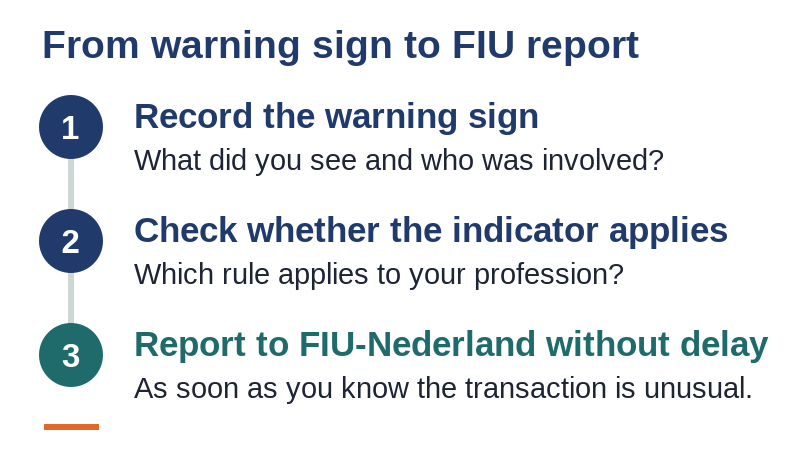
- Record the warning sign Note what happened, who was involved and what you established while providing your services.
- Check whether the indicator applies Pass the warning sign on immediately to the person responsible in your organisation. Record which indicator applies and which facts support your assessment.
- Report without delay Your organisation must report the transaction to FIU-Nederland as soon as it knows the transaction is unusual. An internal review must not delay the report.
What details must you provide?
- The identities of the customer and their UBOs. Where possible, also give the identity of the person for whom the transaction is carried out.
- The type and number of the customer’s identity document and, as far as possible, the same details for the other persons referred to in Article 16.
- The nature, time and place of the transaction.
- The amount, source and destination of the funds or other assets.
- The circumstances that make the transaction unusual.
Use the reporting worksheet to organise the facts. See also what happens after you report to FIU-Nederland.
What may you tell the customer?
Within the limits of Article 23, a lawyer, civil-law notary or tax adviser may try to dissuade a customer from carrying out an unlawful activity. The report itself must remain confidential.
What protection do people who report have?
Article 19 of the Wwft protects you if you report in good faith. Information provided under Article 16 or 17 must not be used against you as grounds for suspicion of money laundering or terrorist financing, or in an investigation or prosecution for either offence. Making a report does not give you immunity for your own involvement.
Unsure whether your services fall within the scope of the Wwft? Start with the Wwft check for your organisation.
FAQs
When must I report an unusual transaction?
Report the transaction to FIU-Nederland without delay once you know it is unusual. This applies to both completed and intended transactions.
What is the difference between objective and subjective indicators?
You must report a transaction as soon as it meets an objective indicator for your profession. For a subjective indicator, you must assess whether the facts suggest a possible link to money laundering or terrorist financing.
What information must I include in a report to FIU-Nederland?
Give details including the parties involved, when and where the transaction took place, and the amount. Describe the source and destination of the funds and the circumstances that make the transaction unusual.
For general information only. This does not constitute legal advice. Consult the current regulations or a qualified adviser about your situation. Spotted an error? Let the editors know.
Customer Diligence is a knowledge base on the Wwft, powered by RiskResolve. It does not provide legal advice.
About · Editorial team and methods · Contact · Privacy · Terms of use · RiskResolve software · UK rules · About this translation
Sources for every article