

Reviews and monitoring
We provide this translation for your convenience. If the versions differ, the Dutch text takes precedence. Read the Dutch page (updated on 21 November 2026). About this translation.
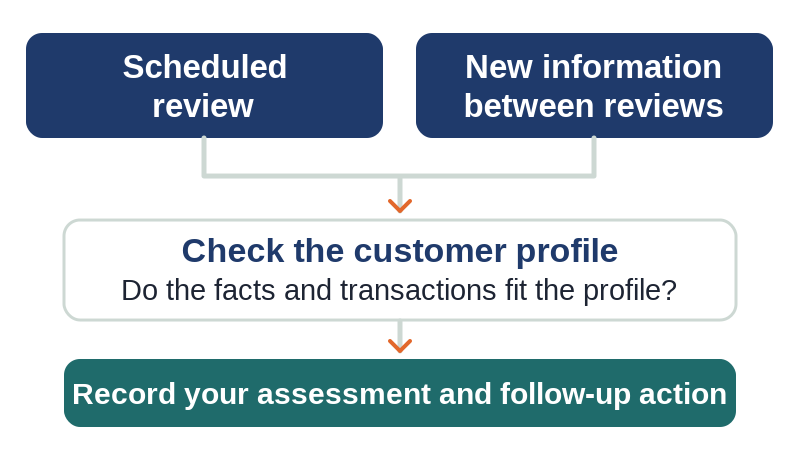
When reviewing a customer file, check that the customer information and risk profile are still accurate. When monitoring the relationship, check transactions against that profile. Article 3 of the Wwft requires ongoing monitoring. Set the frequency of reviews according to the risk. Investigate relevant changes, such as a new owner or payments outside the usual pattern, even between reviews.
When do you reassess a customer?
| Trigger | What do you check? |
|---|---|
| Scheduled review | Are the customer’s details up to date, and is their current risk classification still appropriate? |
| Change between reviews | How would a change such as a new UBO or a different business activity affect the level of risk and what you record in the customer file? |
| Atypical transaction | Is there an explanation for the departure from the expected pattern? Does a reporting indicator for your profession apply to this transaction? |
Record which information you have rechecked and why you are keeping or changing the risk classification. Use the risk assessment to decide when to carry out the next review.
The customer or UBO becomes a PEP
If a prominent public function comes to light during the business relationship, check the potential PEP match. If the customer or a UBO becomes a PEP or you find that they already are one, apply the following measures without delay.
- Obtain approval from senior management to continue the relationship.
- Take appropriate measures to establish the source of wealth and the source of the funds used.
- Carry out enhanced ongoing monitoring of the business relationship.
The special measures also apply to family members specified by law and to people known to be close associates of the PEP. Keep your due diligence records up to date and adjust the frequency of your reviews accordingly.
The prominent public function ends
How do you monitor the business relationship?
From transaction to decision
- Review the expected pattern Check which activities, amounts and counterparties fit the purpose of the business relationship.
- Investigate unexpected activity Compare what happened with what you expected. If necessary, ask about the circumstances and the source of funds. Check the transaction against the reporting indicators that apply to your profession.
- Act on your findings Once you recognise an unusual transaction, you must report it without delay. Record your decision, update the risk profile if necessary and adjust your monitoring. See also the reporting rules.
What can you use software to monitor?
You can set up software to flag cash payments, foreign accounts or changes in transaction volume, for example. Tailor the alerts to the customer and the services you provide.
Who assesses the alert?
The person handling the customer file investigates the alert and checks whether any reporting indicators apply. If you must report a transaction, do so without waiting for the periodic customer review. See transaction monitoring for more detail.
Sources
- Articles 3, 8 and 16 of the Wwft — Dutch legislature, text as at 1 July 2026.
- Wwft Q&As and Good Practices, chapter 4 on ongoing monitoring — DNB, 8 May 2024.
For general information only. This does not constitute legal advice. Consult the current regulations or a qualified adviser about your situation. Spotted an error? Let the editors know.
Customer Diligence is a knowledge base on the Wwft, powered by RiskResolve. It does not provide legal advice.
About · Editorial team and methods · Contact · Privacy · Terms of use · RiskResolve software · UK rules · About this translation
Sources for every article