

How do you justify using simplified due diligence?
We provide this translation for your convenience. If the versions differ, the Dutch text takes precedence. Read the Dutch page (updated on 21 November 2026). About this translation.
To justify simplified due diligence, you must use specific evidence to show that the relationship or transaction, by its nature, poses a low risk of money laundering or terrorist financing. Under Article 6 of the Wwft, you must weigh the relevant risk factors. For example, explain why the engagement letter gives you enough information about the purpose of the relationship. Keep the information up to date and look out for transactions that depart from the expected pattern.
How do you show that the risk is low?
Assess the customer, the work involved, the service, the expected transactions, the delivery channel and the countries involved. Consider at least the factors in Annex II to the EU’s Fourth Anti-Money Laundering Directive. A customer may have an establishment in the Netherlands or may itself be subject to the Wwft. Neither fact alone shows that the risk is low.
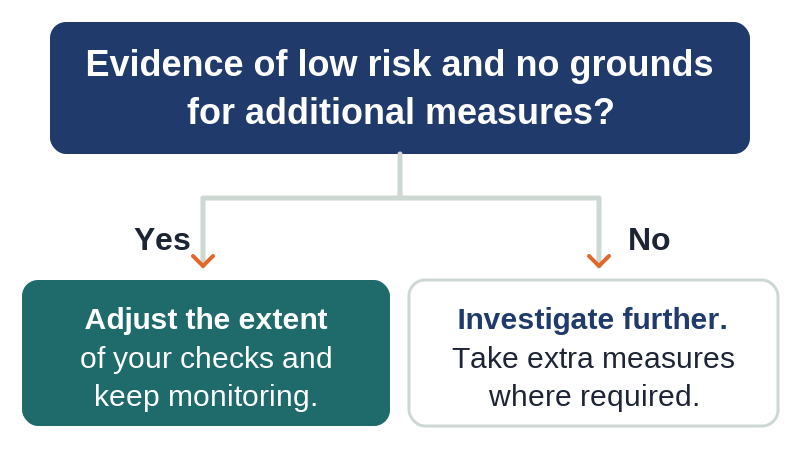
Your policy may set out characteristics that indicate low risk. In your risk assessment, show what evidence you have that these characteristics apply to this customer.
Which checks can you adjust?
| Element | What can you adjust if the evidence shows the risk is low? |
|---|---|
| Identity | Use a reliable source to verify identity. You may dispense with further documents if that source provides sufficient evidence of identity. |
| UBO and structure | If the structure is simple and you have evidence to confirm it, fewer supporting documents may suffice. Identify the UBO and take reasonable measures to verify their identity. Use other information alongside the UBO register. |
| Purpose and intended nature | Use the engagement details if they adequately explain the purpose of the relationship and the expected use of the service. Ask specific follow-up questions if any information is missing. |
| Updates | Set the frequency of reviews according to the risk. Update the information between reviews if relevant circumstances change. |
| Transactions | Adjust the depth and frequency of checks to the risk. Make sure you can identify and report unusual transactions. |
Compare your approach with standard customer due diligence. Section 3.2 of DNB’s guidance explains how to adjust the extent of your checks.
How do you record your decision?
- Describe the facts Record the customer’s activities, structure and expected transactions, along with your sources and the date.
- Assess the risk Explain why the nature of the relationship makes it low risk. Set out any arguments to the contrary that you considered.
- Choose a measure for each element What information do you already have? Why is it enough to answer this question without another document?
- Decide how you will identify changes Record who will update the assessment and what signs should prompt an earlier review.
When is simplified due diligence ruled out?
If information is missing or contradictory, first check whether your reasons for assessing the risk as low still hold. Assess any unusual transaction against the reporting indicators, even if you assessed the customer as low risk when you accepted them.
Which rules apply to electronic money?
Article 7 of the Wwft sets out separate rules for electronic money. These have their own conditions and do not provide a general exemption for other products or activities.
When may you defer verification?
Under Article 4(3), you may verify identity while establishing the business relationship only if this is necessary to avoid disrupting the service and the risk of money laundering or terrorist financing is low. In that case, you must verify identity as soon as possible after first contact.
Give a separate explanation for the timing of verification. Monitor the relationship through your review and monitoring process. A new owner or an unexplained payment may warrant a review sooner than you planned.
What changes on 10 July 2027?
Article 33 of the EU Anti-Money Laundering Regulation (AMLR) applies from that date. It describes simplified measures and the conditions for using them. Until then, use the current Wwft rules to determine whether you may simplify due diligence and when you must verify identity.
Sources
- Wwft, Articles 3, 4, 6, 7, 8 and 16 — Dutch legislature, version of 1 July 2026.
- DNB Wwft Q&As and Good Practices, sections 3.1.4 and 3.2 — DNB, 2024 version.
- Wwft FAQs on types of due diligence — BFT, accessed 21 November 2026. No publication date given.
- Regulation (EU) 2024/1624, Articles 33 and 90 — European Parliament and Council, 31 May 2024. The rules on this subject apply from 10 July 2027.
Review planned before 10 July 2027
The AMLR generally applies from 10 July 2027. The editors will review this page again before that date. Until then, it describes the law as at the reference date. Find out what will change for your organisation.
For general information only. This does not constitute legal advice. Consult the current regulations or a qualified adviser about your situation. Spotted an error? Let the editors know.
Customer Diligence is a knowledge base on the Wwft, powered by RiskResolve. It does not provide legal advice.
About · Editorial team and methods · Contact · Privacy · Terms of use · RiskResolve software · UK rules · About this translation
Sources for every article