

Customer due diligence under the Wwft
We provide this translation for your convenience. If the versions differ, the Dutch text takes precedence. Read the Dutch page (updated on 25 November 2026). About this translation.
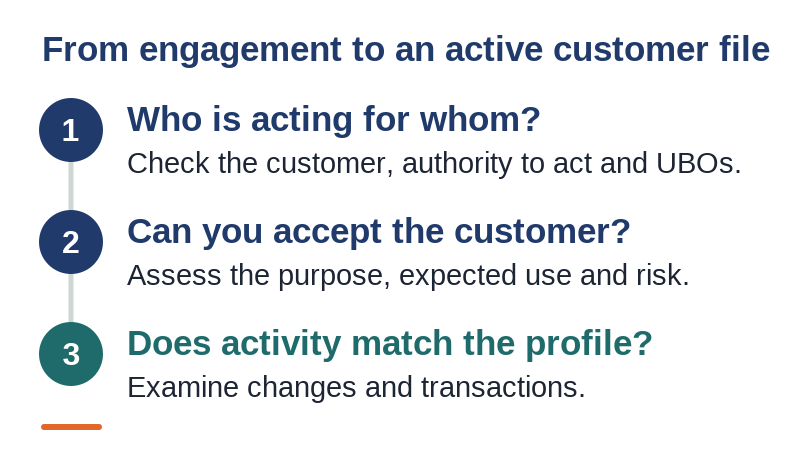
When you carry out customer due diligence under Article 3 of the Wwft, you establish who you are dealing with, who the customer is acting for and what they intend to use your service for. You verify the customer’s identity. If the customer is a Dutch private limited company, you check who ultimately owns or controls it. Throughout the relationship, you compare transactions with what you know about the customer and their activities.
What must you know about the customer?
Customer due diligence (CDD) and ‘know your customer’ (KYC) are common terms for the checks you carry out to understand your customer. Article 3 of the Wwft sets out the required outcomes. Also establish on whose account the customer is acting and what activity to expect.
When do you start customer due diligence?
| Trigger | What to look for |
|---|---|
| Business relationship | You enter into a business relationship in or from the Netherlands. You may need to carry out customer due diligence even if the amount is small. |
| Occasional transaction | The general threshold is €15,000. It also applies where linked transactions together reach that amount. For an occasional transfer of funds under Article 3(5)(g), the threshold is €1,000. |
| Customer warning sign | There are indications of money laundering or terrorist financing, or you doubt the accuracy or completeness of information obtained earlier. |
| Increased risk | The risk associated with an existing customer warrants further due diligence, or the risk is higher because of the country where the customer lives, is established or has its registered office. |
Special rules apply to gambling operators, art dealers and valuers, among others. First check which activity falls under the Wwft and whether you are dealing with a business relationship or an occasional transaction.
Who is the customer and who acts on their behalf?
Start with the engagement and the party you are contracting with. Take reasonable measures to verify whether the customer is acting on their own behalf or for a third party. That third party may also be a customer.
Who is behind the legal person?
If the customer is a legal person, you must identify its UBOs. Take reasonable measures to verify their identities and understand the ownership and control structure. Use other sources alongside information from registers. Separate rules apply to trusts and partnerships.
How do you compile a customer file?
- Identify and verify Verify the customer’s identity using reliable, independent sources, such as a suitable identity document or an extract from the relevant business register.
- Establish each person’s role Check the representative’s authority to act and the scope of any power of attorney, whether the customer acts for anyone else and what role the UBOs play.
- Describe the relationship Record the purpose of the relationship and how the customer is expected to use the service. Where necessary, look into the source of the funds used.
- Assess the risk Consider the customer, service, product, transaction, delivery channel and countries involved. Check whether you need to take specific measures, for example when dealing with a politically exposed person.
- Decide whether to accept the customer Check that you have achieved all the required outcomes. Record your decision and the reasons for it.
- Monitor the relationship Compare transactions with the customer profile. Update the information when relevant circumstances change.
You can use the customer due diligence checklist to record your sources and decision at each step.
How much due diligence is needed?
Consider the risk variables in Annex I to the Fourth Anti-Money Laundering Directive. To apply simplified due diligence, you must be able to show that the risk is low. Take the factors in Annex II into account when doing so. When assessing a higher risk, consider the factors in Annex III.
You must carry out enhanced due diligence where the risk is higher or the law specifically requires it. Use up-to-date information from the EU and the FATF to assess country risk. Check sanctions separately. A favourable risk score does not override a prohibition under sanctions law.
When can you accept the engagement?
If you cannot achieve the required outcome, the general rule is that you must not enter into the relationship or carry out the transaction. You may have to end an existing relationship. Follow the steps for incomplete customer due diligence. Separately, assess whether you have an obligation to report an unusual transaction to FIU-Nederland, the Dutch financial intelligence unit.
What do you track after acceptance?
A new UBO or an unexpected payment may require further due diligence before the next scheduled review. Record what prompted the checks, which sources you consulted and what you concluded. Your organisation retains its own responsibility for due diligence even when a third party carries out the checks.
Keep relevant correspondence, verification records and decisions in a form you can retrieve on request. Limit the personal data you keep to what is necessary for the statutory purpose and observe the retention periods.
What changes on 10 July 2027?
From that date, the EU Anti-Money Laundering Regulation (AMLR) sets its own customer due diligence requirements. Check your forms against the AMLR data requirements in advance.
Sources
- Wwft, Articles 1, 1a, 2b–6, 8, 10, 11, 16, 33 and 34a — Dutch legislature, version of 1 July 2026.
- GDPR, Articles 5 and 6 — European Parliament and Council, 27 April 2016.
- AMLR, Articles 19–22 and 90 — European Parliament and Council, 31 May 2024 (future rules).
- Customer due diligence under the Wwft — DFEI.
For general information only. This does not constitute legal advice. Consult the current regulations or a qualified adviser about your situation. Spotted an error? Let the editors know.
Customer Diligence is a knowledge base on the Wwft, powered by RiskResolve. It does not provide legal advice.
About · Editorial team and methods · Contact · Privacy · Terms of use · RiskResolve software · UK rules · About this translation
Sources for every article