

Preparing a SIRA: example and template
We provide this translation for your convenience. If the versions differ, the Dutch text takes precedence. Read the Dutch page (updated on 25 November 2026). About this translation.
A systematic integrity risk analysis (SIRA) documents how your services could be misused, which controls address those risks and what risk remains. Below you will find an example with three scenarios and a template to download. Article 2b of the Wwft covers money laundering and terrorist financing. The rules for your sector determine whether you also need to assess other integrity risks.
A sample SIRA with three scenarios
This example describes a fictional small bookkeeping firm. The ratings are specific to the example. Use evidence from your own customer base to support your ratings for likelihood and impact. Download the template to get started.
| Scenario | Risk before controls | Control and test | Residual risk and decision |
|---|---|---|---|
| A customer records cash from outside the business as sales revenue (money laundering) | Medium likelihood, high impact. Five customers in the hospitality sector. | Compare cash sales with purchases each quarter. The firm completed the comparison in three of the five customer files. | High. Complete the missing comparisons within a month. The partner will check them. |
| An intermediary refers customers with incomplete details of their structure (money laundering) | Medium likelihood, medium impact. Eight customers came through one intermediary. | The person handling the file checks ownership independently. All eight customer files record the check. | Low. Test the control again when you review the next sample. |
| A foundation pays a group in a conflict zone through an intermediary (terrorist financing) | Low likelihood, high impact. One customer makes or receives cross-border payments. | Obtain details of the recipients and the purpose of the payments. Screen both. The firm did this once. | Medium. Carry out the check for each new recipient from now on. |
Which analysis does your organisation need?
Under Article 2b of the Wwft, you must assess the money laundering and terrorist financing risks your organisation faces. Record the findings and keep them up to date. Make sure the measures you take to identify and assess those risks are proportionate to the nature and size of your organisation.
When does your sector require a broader SIRA?
The rules for your sector may require a broader SIRA. If so, you must also examine other integrity risks, such as corruption or conflicts of interest. DNB gives examples of how to structure the analysis. Your sector and activities determine which requirements apply.
At what level do you assess risk?
| Level | Question | What to record |
|---|---|---|
| Organisation | Where is our service vulnerable to misuse? | Scenarios, controls and priorities. |
| Customer | What risks does this relationship pose? | The customer profile and appropriate due diligence measures. |
| Transaction | Is this transaction consistent with the customer’s profile? | Findings, the decision and, if necessary, a report. |
Finding the same shortcoming in several customer files may justify a change to your quality management system. Conversely, a new scenario may affect individual customer risk assessments.
How do you develop a scenario?
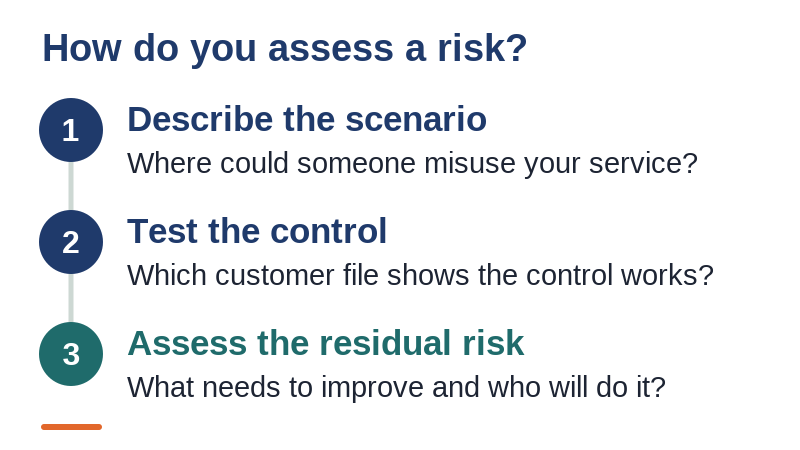
- Describe your activities. Map your customers, services, products, transactions, countries and delivery channels. Ask staff where they see vulnerabilities.
- Describe what could go wrong. Identify the process, the parties involved and the vulnerability. Justify your assessment of the scenario’s likelihood and impact in the absence of controls. Identify any gaps in the data.
- Link a control to the risk. Record who carries out the check, when it takes place and what evidence is available to confirm that it was done.
- Assess the residual risk. Check recent customer files to see whether staff applied the control. Explain your assessment of the risk that remains.
- Make a decision. Record what you will improve or which activity you will restrict. Name the person responsible and specify when you will check the result.
What can you learn from referrals through an intermediary?
How do you show that a control works?
Support your assessment with process descriptions, findings from customer files and decisions. Keep earlier assessments so the board can see why a score or priority changed. You can use the Wwft self-assessment (Dutch) to see which parts of your process need attention.
When should you update the analysis?
Schedule a review that reflects your risks and the rules for your sector. A new service, a change in your customer base, an incident or a recurring shortcoming may call for earlier action. Report your findings and any outstanding actions to management.
What changes from 10 July 2027?
From that date, the EU Anti-Money Laundering Regulation (AMLR) sets the framework for the business-wide risk assessment. As you prepare for the AMLR, also check your analysis against the broader integrity rules for your sector.
Sources
- Wwft, Article 2b — Dutch legislature, text as at 1 July 2026.
- Good Practices SIRA — DNB, 1 July 2025.
- DNB Wwft Q&As and Good Practices, section on risk management — DNB, 2024 version, accessed 21 November 2026.
- Audit firms should put improved policies for managing integrity risks into practice — AFM and BFT, 8 March 2024.
- Regulation (EU) 2024/1624 (AMLR) — European Parliament and Council, 31 May 2024.
Review planned before 10 July 2027
The AMLR generally applies from 10 July 2027. The editors will review this page again before that date. Until then, it describes the law as at the reference date. Find out what will change for your organisation.
For general information only. This does not constitute legal advice. Consult the current regulations or a qualified adviser about your situation. Spotted an error? Let the editors know.
Customer Diligence is a knowledge base on the Wwft, powered by RiskResolve. It does not provide legal advice.
About · Editorial team and methods · Contact · Privacy · Terms of use · RiskResolve software · UK rules · About this translation
Sources for every article