

How do you specify the purpose of the relationship and the customer’s expected activities?
We provide this translation for your convenience. If the versions differ, the Dutch text takes precedence. Read the Dutch page (updated on 21 November 2026). About this translation.
To establish the purpose and intended nature of the business relationship, record why the customer needs your service and how they expect to use it. For a payment account, for example, ask who will pay money into it and why the customer expects to transfer money out. You can then check whether actual transactions match those expectations throughout the relationship, as Article 3(2) of the Wwft requires.
What is the difference between purpose and nature?
The purpose is what the customer wants to achieve, such as investing for retirement. The intended nature is how the customer expects to use your service. In this example, that includes the investment period and the contributions and withdrawals they expect to make.
Article 3(2)(c) and (d) of the Wwft links this part of customer due diligence to ongoing monitoring. First establish whether you are assessing a business relationship or an occasional transaction.
What follow-up question will give you a useful answer?
| The customer says | Follow up | Record |
|---|---|---|
| ‘Financial advice’ | What decision do you need advice on? | The specific question and the limits of the engagement. |
| ‘Payments’ | Who do you expect to receive payments from, and what will you pay for? | Types of incoming and outgoing payments and types of counterparty. |
| ‘We operate internationally’ | Which countries do you operate in, and what do you do in each? | The countries involved and the business reason for the customer’s contacts in each. |
| ‘Investing’ | What are you investing for, and for how long? | The purpose, investment period and expected contributions or withdrawals. |
| ‘We’re going to grow’ | What new activity are you planning? | The planned expansion and the role your service will play in it. |
Choose questions that suit your service and the level of risk. A range may be enough to spot a departure from the expected pattern later. Note whether the figures come from contracts, past turnover or a forecast.
What information do you already have?
- Read the terms of engagement and the onboarding records The agreement or the customer’s choice of product may already tell you enough to establish the purpose. Check what they tell you about how the customer will use the service.
- Follow up on outstanding questions If it is unclear why the customer is seeking services in the Netherlands, ask why they need this particular service here.
- Explain the basis for your assessment Compare the answer with the customer’s activities and the available documents. Record the pattern you expect so you can check actual activity against it.
According to DNB, if you have established that the risk is low and the product has a specific use, the product itself may indicate the purpose. Comparing the customer with a group of sufficiently similar customers may also help if the relevant conditions are met. Explain why this approach is appropriate for this customer.
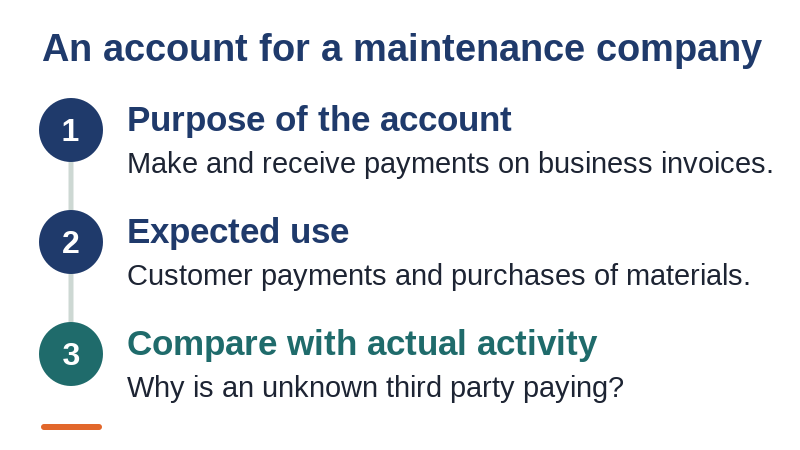
How do you describe a payment account?
What belongs in the customer file?
- The customer’s explanation and the date of the conversation.
- The documents that support the explanation and any points that remain uncertain.
- Your assessment of how plausible the explanation is and how you expect the customer to use the service.
- Any outstanding questions and when you will follow up.
Match the depth of your enquiries to the risk. If the facts warrant it, also examine the source of funds or source of wealth.
What if use of the service changes?
Use the profile during customer reviews and ongoing monitoring. There may be an explanation for a departure from the expected pattern, or you may need to investigate further. Use the applicable indicators to assess whether you have an obligation to report the transaction as unusual to FIU-Nederland, the Dutch financial intelligence unit.
What if the purpose is still unclear?
Is the purpose still unclear despite specific follow-up questions? Record what you have been unable to establish and assess what this means for the relationship under the rules on incomplete customer due diligence.
Which rules apply from 10 July 2027?
Article 25 of the EU Anti-Money Laundering Regulation (AMLR) sets out in more detail how to assess the purpose and intended nature of a business relationship or an occasional transaction. These rules apply from 10 July 2027.
Sources
- Articles 3(2)(c) and (d), 3(7), 3(10) and 5 of the Wwft, Dutch legislature, version as at 1 July 2026.
- Wwft Q&As and Good Practices, section 3.1.5, DNB, 2024 version.
- Leidraad Wwft en Sanctiewet, sections 5.3 and 5.4 — AFM, 5 June 2024.
- Regulation (EU) 2024/1624, Articles 25 and 90, European Parliament and Council, 31 May 2024. The rules on this subject apply from 10 July 2027.
Review planned before 10 July 2027
The AMLR generally applies from 10 July 2027. The editors will review this page again before that date. Until then, it describes the law as at the reference date. Find out what will change for your organisation.
For general information only. This does not constitute legal advice. Consult the current regulations or a qualified adviser about your situation. Spotted an error? Let the editors know.
Customer Diligence is a knowledge base on the Wwft, powered by RiskResolve. It does not provide legal advice.
About · Editorial team and methods · Contact · Privacy · Terms of use · RiskResolve software · UK rules · About this translation
Sources for every article