

How do you identify the UBO through a chain of companies?
We provide this translation for your convenience. If the versions differ, the Dutch text takes precedence. Read the Dutch page (updated on 21 November 2026). About this translation.
To identify the ultimate beneficial owners of a Dutch private limited company with intermediate holding companies, trace shareholdings, voting rights and other forms of control through each company to the natural persons who ultimately hold or exercise them. Add up each person’s separate interests in the customer. Check who has the power under any agreements to determine what the company decides. For each link in the chain, record which documents support your conclusion.
Which company’s UBO are you identifying?
This guidance applies to ordinary Dutch private and public limited companies. An exception applies to listed companies that meet the prescribed disclosure requirements and to their wholly owned subsidiaries. Different UBO criteria apply to other legal forms.
- Start with the customer Record the company’s legal name and identify who directly holds shares, voting rights or another ownership interest.
- Follow each link in the chain If a holding company owns the interest, identify the people behind it. Record who has appointment rights or controls what the company decides in practice.
- Reach a conclusion for each person Record the interests and rights each person holds and whether, taken together, they qualify that person as a UBO. Identify the UBO and take reasonable measures to verify their identity.
What evidence supports each link in the chain?
| Question | Possible source |
|---|---|
| Who holds which interest in each company? | Compare the register of shareholders with information from relevant registers and with the transfer documents. |
| Do shareholdings, voting rights and profit rights align? | Check the articles of association and the rights attached to each class of shares. |
| Who can appoint directors or control what the company decides? | Check the arrangements between shareholders and examine how decisions are made in practice. |
| Which person ultimately holds the rights? | Record the basis for your conclusion on UBO status, the person’s identification data and the steps you took to verify their identity, including the outcome. |
For each document, record its date and the link in the chain it supports. If a declaration names only a holding company, ask for the specific information you still need.
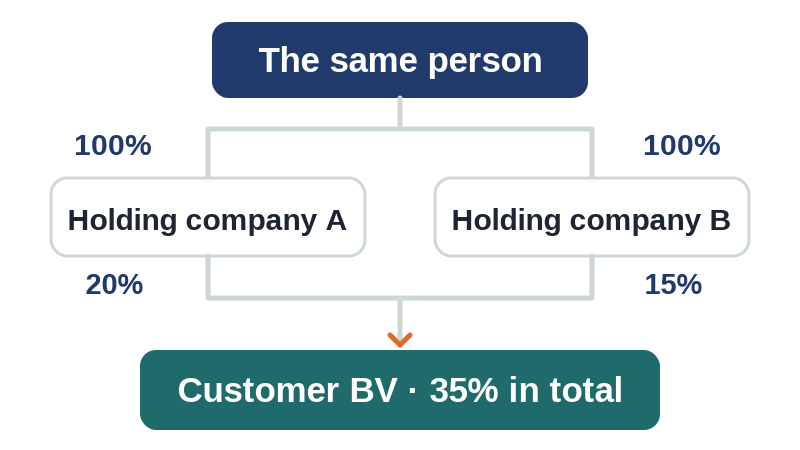
How do you add two interests together?
Who has control via other means?
A holding of exactly 25% does not meet the current percentage threshold. Even where a holding is small, check who can exercise decisive influence. Examine the agreements, appointment rights and how decisions are made in practice.
What if the result is 24%?
A right that merely protects a minority shareholder does not automatically confer ultimate control. Check which decisions the right covers and who has the final say.
What should you do if documents are missing or contradict each other?
Compare your findings with the UBO register. If you find a discrepancy, check the date and content of both sources. Record why each person qualifies or does not qualify as a UBO and assess whether you need to submit a discrepancy report.
When might a pseudo-UBO be relevant?
Which threshold applies from 10 July 2027?
Article 52 of the EU Anti-Money Laundering Regulation (AMLR) sets a threshold of 25% or more for the ownership interest in question. It also sets out rules for indirect interests. Separate criteria apply to control.
Keep records for each link in the chain so that, from that date, you can reassess your conclusion under the AMLR rules on beneficial ownership.
Sources
- Article 3 of the Uitvoeringsbesluit Wwft 2018 — Dutch legislature, version of 30 April 2026.
- Article 3 of the Wwft — Dutch legislature, version of 1 July 2026.
- DNB Wwft Q&As and Good Practices, section 3.1.4 — DNB, 2024 edition.
- Sector-specific Wwft guidance for accountants, tax advisers and bookkeeping firms, section 7.2.4 — BFT, 24 October 2024.
- Articles 51–54 and 90 of Regulation (EU) 2024/1624 — European Parliament and Council of the European Union, 31 May 2024. The rules on this subject apply from 10 July 2027.
Review planned before 10 July 2027
The AMLR generally applies from 10 July 2027. The editors will review this page again before that date. Until then, it describes the law as at the reference date. Find out what will change for your organisation.
For general information only. This does not constitute legal advice. Consult the current regulations or a qualified adviser about your situation. Spotted an error? Let the editors know.
Customer Diligence is a knowledge base on the Wwft, powered by RiskResolve. It does not provide legal advice.
About · Editorial team and methods · Contact · Privacy · Terms of use · RiskResolve software · UK rules · About this translation
Sources for every article