

How do you carry out due diligence on a trust or a similar legal arrangement?
We provide this translation for your convenience. If the versions differ, the Dutch text takes precedence. Read the Dutch page (updated on 21 November 2026). About this translation.
Article 3(3) of the Wwft applies if your customer acts as a trustee or on behalf of a similar legal arrangement. You must carry out customer due diligence on both the customer and the arrangement. Check the deed and any subsequent amendments to establish who currently has authority to act. Identify the ultimate beneficial owners for each role and take reasonable measures to verify their identity.
Who is giving the instructions?
Article 3(3) of the Wwft applies when the customer acts as a trustee or on behalf of another legal arrangement. Ask which arrangement the customer represents and which law governs it. Instructions given in the customer’s own name may still concern trust assets.
- Establish the capacity in which the customer acts Record who gives the instructions, which trust they are acting for and who signs on behalf of the trustee.
- Check the authority to act Compare the trust deed with the latest appointments and amendments. Also check the signatory’s authority to act as a representative or under a power of attorney.
- Map out the roles of those involved For each statutory role, record who holds it and the source that confirms this. Identify the UBOs and take reasonable measures to verify their identity.
This guidance covers customer due diligence on the trust. For trust offices that provide trust services in the course of business, Article 3(13) of the Wwft refers to Chapter 4 of the Dutch Act on the Supervision of Trust Offices 2018.
Which roles do you check?
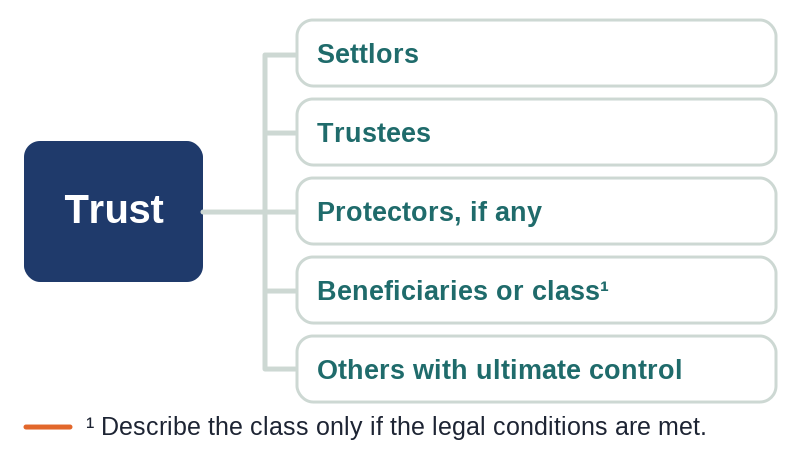
| Statutory role | What do the documents tell you? |
|---|---|
| Settlors | Who set up the trust? Check the documents establishing it. |
| Trustees | Who manages the trust assets? Check appointments, replacements and current powers. |
| Protectors, if any | Who has the power, for example, to approve an appointment or a decision? If there is no protector, record how you established this. |
| Beneficiaries | Who is entitled to distributions? Where the law allows it, record a description of the class of beneficiaries. |
| Others who exercise ultimate control | Who ultimately controls the trust, directly or indirectly, through ownership or other means? |
Article 3(1)(e) of the Wwft Implementation Decree 2018 lists these categories. Paragraph 5 applies to similar legal arrangements.
What if a legal person is a trustee or beneficiary?
Apply the UBO rules for that entity in accordance with Article 3(7) of the Wwft Implementation Decree. Document the link from the trust role, through the entity, to the natural persons you identified. For a Dutch private limited company, this may require you to examine a holding company structure.
What if the individual beneficiaries have yet to be determined?
If it is not yet possible to determine who the individual beneficiaries are, describe the class of people the trust was set up or operates principally to benefit. Record the eligibility criteria and the relevant powers. For certain Dutch funds for joint account, a separate rule with its own conditions governs the treatment of beneficiaries as a class.
Article 4(6) of the Wwft allows you to identify a beneficiary at a later stage in limited circumstances. Before entering into the business relationship or carrying out the occasional transaction, describe the beneficiary by particular characteristics or by class. Obtain enough information in advance to establish their identity at the time of payout or when they exercise their vested rights. This exception applies only to beneficiaries.
Which appointment applies today?
When is the customer file complete?
Record the purpose and structure of the arrangement. Keep up-to-date documents with their sources and dates. Link them to your records of identification, verification, roles and control.
What proof of registration do you need?
When you enter into a new business relationship with a customer acting in the capacity described in Article 3(3), you need proof of registration in the Dutch trust register or the corresponding register in another EU Member State. You must also check whether the UBOs are registered (Article 4(7) of the Wwft). The trust register has its own access rules. Read about how it differs from the ordinary UBO register.
Register information alone is insufficient. Do not designate a pseudo-UBO to stand in for a missing trust role. Record what information you still need. If customer due diligence is incomplete, assess whether you can enter into or continue the business relationship.
What changes on 10 July 2027?
Articles 58 to 60 of the EU Anti-Money Laundering Regulation (AMLR) set out more detailed rules on trusts and beneficiaries, including rules for discretionary trusts. Review your procedures before the date of application.
Sources
- Wwft, Articles 3, 4, 5 and 11 — Dutch legislature, version as at 1 July 2026.
- Uitvoeringsbesluit Wwft 2018, Article 3(1)(e) and paragraphs 5 to 7 — Dutch government, version as at 30 April 2026.
- Wwft Q&As and Good Practices, section 3.1.4 — DNB, 2024 edition.
- Regulation (EU) 2024/1624, Articles 58–60 and 90 — European Parliament and Council, 31 May 2024. The rules on this topic apply from 10 July 2027.
Review planned before 10 July 2027
The AMLR generally applies from 10 July 2027. The editors will review this page again before that date. Until then, it describes the law as at the reference date. Find out what will change for your organisation.
For general information only. This does not constitute legal advice. Consult the current regulations or a qualified adviser about your situation. Spotted an error? Let the editors know.
Customer Diligence is a knowledge base on the Wwft, powered by RiskResolve. It does not provide legal advice.
About · Editorial team and methods · Contact · Privacy · Terms of use · RiskResolve software · UK rules · About this translation
Sources for every article