

Wwft – high-risk country
We provide this translation for your convenience. If the versions differ, the Dutch text takes precedence. Read the Dutch page (updated on 21 November 2026). About this translation.
In brief A link to a high-risk third country identified by the European Commission may require you to carry out additional customer due diligence under Articles 8 and 9 of the Wwft. Check where your customer lives or is established and whether the relationship or transaction has a link to such a country. Take any relevant listing on the FATF grey list into account in your risk assessment. Separate criteria apply to sanctions and to reporting.
The lists below are relevant to Wwft checks in the European part of the Netherlands. They show the position as at 21 November 2026.
Which list is the country on?
EU list of high-risk third countries
The list appears in the Annex to Commission Delegated Regulation (EU) 2016/1675. The latest amendments have applied since 29 January 2026. The EU added Russia, Bolivia and the British Virgin Islands. It removed Burkina Faso, Mali, Mozambique, Nigeria, Tanzania and South Africa. See the consolidated Annex and amending Regulations 2026/46 and 2026/83.
| Initial letter | Countries and territories |
|---|---|
| A–D | Afghanistan, Algeria, Angola, Bolivia, British Virgin Islands, Democratic Republic of the Congo. |
| H–K | Haiti, Iran, Côte d’Ivoire, Yemen, Cameroon, Kenya. |
| L–N | Laos, Lebanon, Monaco, Myanmar, Namibia, Nepal, North Korea. |
| R–Z | Russian Federation, Syria, Trinidad and Tobago, Vanuatu, Venezuela, Vietnam, South Sudan. |
FATF blacklist of 30 October 2026
The FATF calls for countermeasures against Iran and North Korea. For Myanmar, it calls for enhanced due diligence proportionate to the risk. See the FATF call for action by country.
FATF grey list of 30 October 2026
These countries and territories are working on agreed improvements under increased monitoring by the FATF. Take the findings into account in your risk assessment. The FATF says that inclusion on its grey list does not automatically require enhanced due diligence. See the FATF statement on jurisdictions under increased monitoring.
| Initial letter | Countries and territories |
|---|---|
| A–B | Angola, Bolivia, Bosnia and Herzegovina, British Virgin Islands. |
| H–K | Haiti, Iraq, Yemen, Cameroon, Kenya, Kuwait. |
| L–P | Lao PDR, Lebanon, Nepal, Papua New Guinea. |
| S–Z | Syria, Venezuela, Vietnam, South Sudan. |
The FATF removed Bulgaria, the Democratic Republic of the Congo, Côte d’Ivoire and Monaco from its grey list on 30 October. The EU decides independently which countries to list. See the decision of the FATF Plenary.
When does the Wwft require additional due diligence?
| Link to an EU-listed high-risk third country | What to do |
|---|---|
| Your customer lives there, is established there or has its registered office there | You must carry out enhanced due diligence under Article 8 of the Wwft. You must also carry it out if your own assessment identifies a higher risk. |
| A transaction, business relationship or correspondent banking relationship has a link to the country | You must apply the additional measures under Article 9 of the Wwft. These can apply even if your customer is Dutch. |
Article 8(11) provides an exception for a branch or majority-owned subsidiary of an obliged entity established in an EU Member State or another EEA state. If the branch or subsidiary complies fully with the group procedures under Article 2f, you may tailor your customer due diligence to the risk.
Article 9 requires you to obtain additional information on the customer and the beneficial owner, the purpose and nature of the relationship, the source of funds, the source of wealth and the reasons for the transactions. You must obtain approval from senior management before entering into or continuing the business relationship. You must also step up monitoring. Read how to carry out enhanced due diligence.
How do you assess a country for your file?
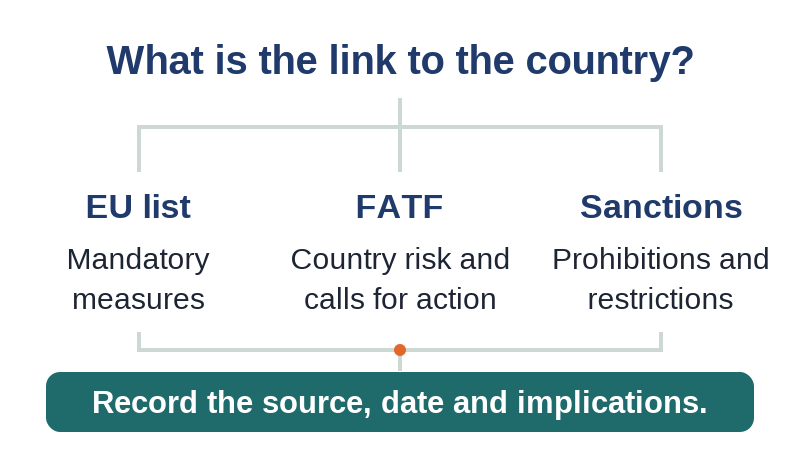
- Identify the link to the country Consider who is involved, where the parties are established, what activities they carry out and the source and destination of the funds. To assess that link, you need more than a UBO’s nationality.
- Check the sources Consult the current EU Annex and both FATF lists. Also check the sanctions rules that apply to the parties, goods and services involved.
- Record your decision Note the date, the version of the list, the measures you take and who is responsible. When a list changes, assess which existing customer files you need to review.
When do blocking or reporting duties apply?
The general objective indicator for reporting transactions involving EU-listed high-risk third countries no longer applies. Even if the country does not appear on any of the lists, take the other facts into account in your risk assessment.
What changes from 2027?
The EU Anti-Money Laundering Regulation (AMLR) applies to this area from 10 July 2027. Before then, check the EU rules on third countries again and see which measures apply.
Official sources for rechecking a country’s status
- Wwft, Articles 8 and 9.
- European Commission, current EU list and amendments.
- FATF, current black and grey lists.
- Dutch government, international sanctions.
- Staatsblad 2019, 310, repeal of the objective indicator.
FAQs
Where can I find the current country risk lists?
You can find the EU list in Delegated Regulation 2016/1675 and its amendments on EUR-Lex. The FATF website lists the jurisdictions subject to a call for action and those under increased monitoring.
Must I carry out enhanced due diligence if a country on the FATF grey list is involved?
Consider the specific link to the country in your risk assessment. Inclusion on the grey list does not in itself create a general obligation to carry out enhanced due diligence. Check whether the country is also on the EU list.
Is there a ban on doing business with a high-risk country?
Inclusion on the EU list of high-risk third countries or on either FATF list does not in itself impose a general ban on transactions. Check separately whether a sanctions regime prohibits or restricts the transaction.
For general information only. This does not constitute legal advice. Consult the current regulations or a qualified adviser about your situation. Spotted an error? Let the editors know.
Customer Diligence is a knowledge base on the Wwft, powered by RiskResolve. It does not provide legal advice.
About · Editorial team and methods · Contact · Privacy · Terms of use · RiskResolve software · UK rules · About this translation
Sources for every article