

Risk assessment for customer due diligence
We provide this translation for your convenience. If the versions differ, the Dutch text takes precedence. Read the Dutch page (updated on 21 November 2026). About this translation.
Assess the risk of money laundering and terrorist financing for each customer. Compare the facts in the customer file with your firm’s business-wide risk assessment under Article 2b of the Wwft. Consider, for example, the owners, the service the customer wants, the payments you expect and the countries involved. Record which facts determined your assessment of this customer and why the controls you chose are appropriate.
What risks does your firm face?
Articles 2b and 2c of the Wwft require a risk assessment and policies proportionate to the nature and size of the obliged entity. Describe the customers you serve, the services you provide and how your staff manage the risks. Keep the assessment available to your supervisor.
From firm policy to the customer file
- Establish the facts Record who the customer is, which service they want and which payments you expect.
- Weigh the risks Apply the same principles to every customer. Use specific facts to explain which factors increase or reduce the risk.
- Choose the measures Decide what due diligence you need to carry out and assess the residual risk. Record whether you can enter into or continue the business relationship.
- Review the customer file Compare the customer’s actual activities with what you expected. Adjust the risk profile and controls if, for example, ownership or the flow of funds changes.
What should you ask about each risk factor?
The questions below help you take account of the risk factors in the EU’s Fourth Anti-Money Laundering Directive. Add questions about risks specific to your firm or sector.
| Risk factor | Question for your file |
|---|---|
| Customer and ownership | Who ultimately has control? Can you explain why there are several companies between the customer and the owner? |
| Product or service | Does the proposed work fit the customer’s business? How do you verify the value of assets such as art or property? |
| Transaction | Is the size of the payment consistent with turnover? Is the proportion of payments made in cash what you would expect for this business? |
| Delivery channel | Are you in direct contact with the customer or do you work through an intermediary? How do you establish who is acting on the customer’s behalf? |
| Country | Where is the customer based, where do they supply their products and where does the payment come from? |
Can you explain ownership and turnover?
An unnecessarily complex group structure can make it difficult to identify the ultimate beneficial owner. Examine the role of each company.
For a cash-intensive business, such as one in the hospitality sector, the main question is whether its cash receipts are consistent with its activities. Even within a single sector, assess each business individually.
Why has the customer chosen your service?
Has a customer from outside the area you serve asked for an unusual service? Ask why they chose your firm and how the work relates to their business activities. For items that are difficult to value, such as works of art, you can ask for evidence to support the price.
Which countries are involved?
Consider the customer’s place of business, their buyers and deliveries, and the origin and destination of funds. A UBO’s nationality may form part of that assessment. If you identify a geographical link, check the EU and FATF country lists.
Also check compliance with the applicable sanctions rules. Include EU sanctions and the Dutch national terrorism sanctions list in your checks. The Netherlands implements United Nations sanctions through EU or national rules. Assess separately whether US sanctions are relevant. See how to carry out a sanctions check.
How much customer due diligence is needed?
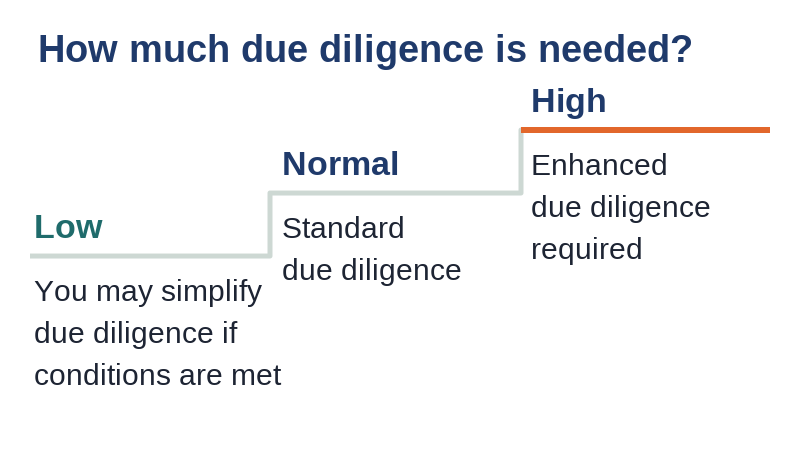
Use the risk classification matrix to record your reasoning. The Wwft scan (Dutch) helps you review the procedures your firm has in place for risk assessment and customer due diligence.
To add up the scores for the individual risk factors, use the risk calculator. The white paper on risk assessment and risk classification (Dutch) explains in more detail how to use your assessment to assign a risk category and record your decision.
FAQs
Which risk factors should I consider in customer due diligence?
Consider the customer, products, services, transactions, how you deliver your services and the countries involved. Which factors carry the most weight depends on your firm and the business relationship.
Why does a complex group structure matter?
An unusual structure can make it difficult to identify the UBOs. Ask why the structure is in place and use the facts to support your assessment.
What do I need to record after the risk assessment?
Record the facts you considered, the conclusion you reached and the measures appropriate to the risk. Keep the assessment up to date so you can show it to the supervisor for your sector on request.
For general information only. This does not constitute legal advice. Consult the current regulations or a qualified adviser about your situation. Spotted an error? Let the editors know.
Customer Diligence is a knowledge base on the Wwft, powered by RiskResolve. It does not provide legal advice.
About · Editorial team and methods · Contact · Privacy · Terms of use · RiskResolve software · UK rules · About this translation
Sources for every article