

Enhanced due diligence
We provide this translation for your convenience. If the versions differ, the Dutch text takes precedence. Read the Dutch page (updated on 21 November 2026). About this translation.
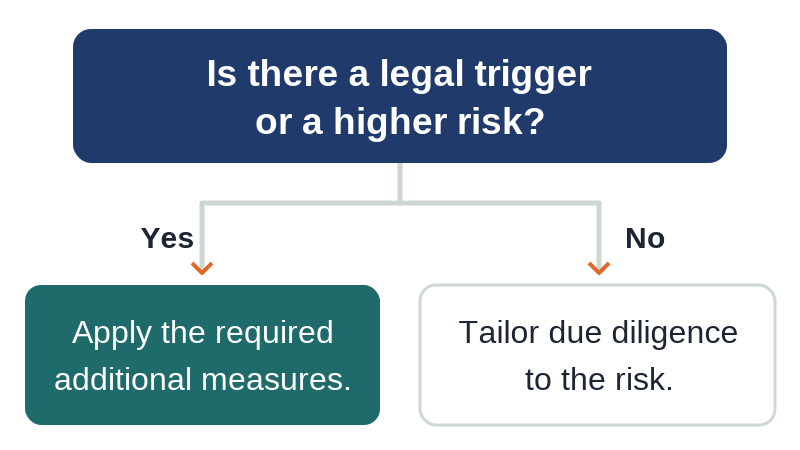
Article 8 of the Wwft requires enhanced due diligence if a business relationship or transaction, by its nature, poses a higher risk of money laundering or terrorist financing. Identify the facts that warrant further checks and the measures the law requires in your circumstances. For example, if the customer is a politically exposed person, investigate their source of wealth and the source of funds used in the relationship or transaction.
When are additional checks mandatory?
Your assessment indicates a higher risk
Consider the customer, the product, the service, the transaction, the delivery channel and the countries involved. Annex III to the EU’s Fourth Anti-Money Laundering Directive gives examples of factors that may indicate a higher risk. Record your own risk assessment and focus your additional checks on the risks you have identified.
The customer or transaction has a link to an EU-listed high-risk third country
Is the customer resident or established in a listed country, or do they have their registered office there? If so, Article 8 of the Wwft requires you to carry out enhanced due diligence. Article 9 also applies to transactions, business relationships and correspondent banking relationships linked to such a country. Consult the country lists and their reference dates.
Article 8(11) provides a limited exception for a branch or majority-owned subsidiary of an obliged entity established in an EU Member State or another EEA state. The exception applies if the branch or subsidiary complies fully with the group-wide procedures under Article 2f. In that case, tailor your customer due diligence to the risk.
Article 9 requires the following measures where there is a relevant link to a listed country.
- Collect additional information about the customer, the UBO and the purpose and nature of the business relationship.
- Investigate the source of funds used and the source of wealth of both the customer and the UBO. Establish the background to the intended or completed transactions and the reasons for them.
- Obtain approval from senior management to enter into or continue the business relationship.
- Carry out more checks, update the information more often and select transaction patterns for closer examination.
PEP measures apply to the customer or UBO
Establish whether the customer or UBO is a politically exposed person (PEP), a family member of a PEP or a person known to be a close associate of a PEP. Obtain approval from senior management before entering into or continuing the business relationship or carrying out the transaction.
Take appropriate measures to establish the source of wealth and the source of funds used. Carry out enhanced ongoing monitoring of the business relationship. See who is covered by PEP measures.
A transaction warrants closer examination
Examine the background and purpose of a transaction if it is complex or unusually large, follows an unusual pattern or has no apparent economic or lawful purpose. Any one of these features is enough. Apply enhanced monitoring to the entire business relationship.
Your institution enters into a correspondent relationship
Does your bank or financial undertaking make payments through a correspondent relationship with a respondent institution outside the EU/EEA? If so, Article 8(4) of the Wwft applies. You must assess the respondent institution itself. This includes examining its activities and reputation, how it is supervised and what controls it has in place. Record each institution’s responsibilities and obtain the required approval in advance.
Which documents do you need for this customer file?
- Identify the unanswered question For example, note that the sale agreement does not explain why a third party is paying the purchase price.
- Look for evidence that answers the question For example, ask for the loan agreement and bank statements. If you are unsure who has authority to act, powers of attorney, segregation of duties and internal controls may be relevant.
- Decide and follow up Record what the documents explain, what risk remains and who makes the decision. Decide how you will continue to monitor the relationship. If you cannot complete the required customer due diligence, apply Article 5 of the Wwft.
Depending on the risk, documents relating to intermediaries, fraud prevention or codes of conduct may also be relevant, as may a Dutch certificate of conduct issued to a legal person. For each document you request, note the question you want it to answer.
FAQs
When must I carry out enhanced due diligence?
For example, you must carry out enhanced due diligence if a business relationship or transaction poses a higher risk. The same applies if the customer lives in a high-risk third country identified by the European Commission, is established there or has their registered office there.
What extra checks do I make if the customer or a UBO is a PEP?
Take appropriate steps to establish the source of wealth and the source of funds used. You must also obtain approval from senior management for the business relationship and carry out enhanced ongoing monitoring.
How do I investigate an unusual transaction pattern?
Examine the background and purpose of the transactions. Carry out enhanced monitoring of the entire business relationship and check the transactions against the reporting indicators that apply to you as an obliged entity.
For general information only. This does not constitute legal advice. Consult the current regulations or a qualified adviser about your situation. Spotted an error? Let the editors know.
Customer Diligence is a knowledge base on the Wwft, powered by RiskResolve. It does not provide legal advice.
About · Editorial team and methods · Contact · Privacy · Terms of use · RiskResolve software · UK rules · About this translation
Sources for every article