

Tax evasion and avoidance under the Wwft
We provide this translation for your convenience. If the versions differ, the Dutch text takes precedence. Read the Dutch page (updated on 21 November 2026). About this translation.
In brief Tax evasion means deliberately breaking tax rules. Tax avoidance means using lawful arrangements to reduce tax. The benefit gained through evasion may constitute proceeds of crime. Identify the transaction you encounter in the course of your work and check it against the reporting indicators for your profession. If it is unusual, Article 16 of the Wwft requires you to report it even if the customer wants to correct their return.
What is the difference?
| Term | What do you see? | What do you check? |
|---|---|---|
| Tax evasion | A customer deliberately conceals turnover or deducts fictitious expenses. | What benefit might the tax offence have generated? Which transaction is linked to it? |
| Tax avoidance | The customer obtains a tax advantage by lawful means. | Is the information used accurate, and do the applicable rules allow the arrangement? |
| Tax error | An amount on the tax return differs from the amount in the accounts. | For example, is this a transcription error, a difference of interpretation or a deliberate misstatement? |
A customer’s use of the term ‘tax planning’ tells you little about the facts. Read the underlying documents. Even where a tax advantage is lawful, other facts may give you grounds to report a transaction.
How can tax evasion lead to money laundering?
Money a person retains as a result of a tax crime can itself be proceeds of crime. Distinguish the turnover originally earned from the benefit gained through evasion. Paying tax does not make the proceeds of another crime lawful either.
How certain do you need to be before you report?
When assessing possible money laundering, consider where the property came from, what was done with it and what the person concerned knew or should have suspected. An additional tax assessment alone does not prove intent. You do not need to wait for a criminal conviction before reporting under the Wwft.
When must you report to FIU-Nederland?
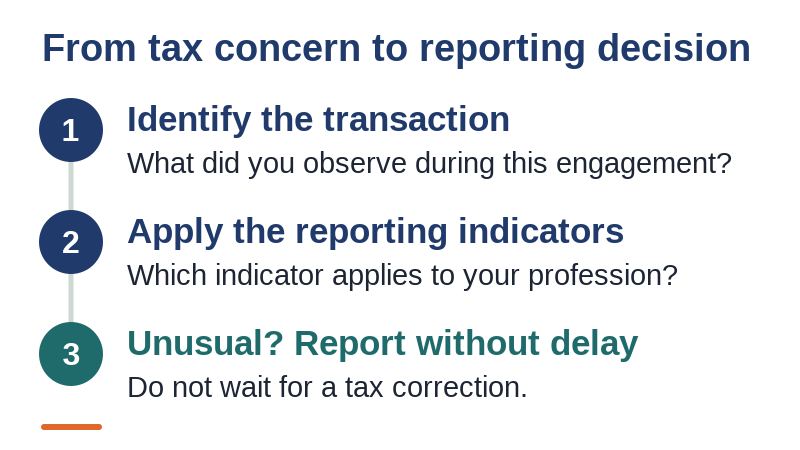
- Identify the transaction Does your engagement fall within the scope of the Wwft? Describe the completed or intended transaction you encounter during the engagement.
- Apply the indicators Check the objective and subjective indicators for your profession. The subjective indicator applies when the facts give you reason to believe the transaction may be linked to money laundering or terrorist financing.
- Record your assessment and report promptly Note the facts, the explanation given and what supports or contradicts it. Once you know the transaction is unusual, you must report it without delay. See also the reporting procedure and confidentiality rules.
What does a missing invoice tell you?
What if the customer wants to correct the error?
When you record your decision on the tax correction and reporting obligation, make clear what information you had and when.
Which rules apply from 10 July 2027?
The reporting rules under the EU Anti-Money Laundering Regulation (AMLR) apply from that date. Until then, assess the transaction under the current Wwft and check it against the indicators for your profession.
Sources
- Wwft, Articles 1, 1a and 16 — Dutch legislature.
- Uitvoeringsbesluit Wwft 2018, list of indicators — Dutch legislature.
- Tackling tax evasion — Government of the Netherlands.
- Tax avoidance: replies to parliamentary questions, answer 3 — Dutch Ministry of Finance.
- What is money laundering? — FIU-Nederland.
- Guidance for tax professionals (Specifieke leidraad fiscale beroepsgroepen), sections 2.2 and 9.1 — BFT.
- Preparing for the new EU rules — AFM.
FAQs
What is the difference between tax evasion and tax avoidance?
A person who evades tax deliberately breaks the tax rules, for example by concealing turnover. A person who engages in tax avoidance uses lawful means to reduce their tax liability.
Do I have to report every error in a tax return?
Find out what happened. Identify the transaction and check it against the reporting indicators for your profession. A missing invoice alone does not prove intent.
What if the customer wants to correct their tax return?
Record the correction separately from your decision on whether to report. If you already have a duty to report the transaction to FIU-Nederland, the Dutch financial intelligence unit, the customer’s willingness to correct the return does not in itself remove that duty.
For general information only. This does not constitute legal advice. Consult the current regulations or a qualified adviser about your situation. Spotted an error? Let the editors know.
Customer Diligence is a knowledge base on the Wwft, powered by RiskResolve. It does not provide legal advice.
About · Editorial team and methods · Contact · Privacy · Terms of use · RiskResolve software · UK rules · About this translation
Sources for every article