

How to assess and record a potential match in a PEP check
We provide this translation for your convenience. If the versions differ, the Dutch text takes precedence. Read the Dutch page (updated on 21 November 2026). About this translation.
If you find a potential PEP match, check whether it concerns your customer or their ultimate beneficial owner. Check whether the rules for politically exposed persons cover the role or relationship identified. For example, compare the date of birth, public function and dates in office with the details given in the source. Record why you ruled out the match, decided to investigate further or confirmed it. Also record which measures Article 8 of the Wwft requires.
Which public functions and relationships do you check?
A PEP holds or has held a prominent public function, for example as a minister or a member of parliament. Check which office the person holds or held and for what period. A public profile, a political opinion or a news report is insufficient on its own.
Also check whether the customer or UBO is a family member covered by law or a person known to be a close associate of a PEP. Examples include a parent, partner or child of the PEP, or someone who shares ultimate beneficial ownership of a business with the PEP. The PEP declaration page explains who qualifies as a PEP and provides a template for requesting the information.
How do you investigate a potential match?
- Check the details you entered Compare the name with the verified customer information. If the potential match concerns a UBO, check that you screened the right person.
- Read the source Which public function or relationship does it identify? In which country and over what period? If necessary, ask specific questions and carry out your own research.
- Compare the two people’s details Look at their dates of birth, career histories and nationalities, among other details. If the information conflicts, ask specific follow-up questions.
- Record your conclusion Note the source, the date, the information that determined the outcome and who will follow up any outstanding questions. Include only relevant personal data.
Which outcome do you record?
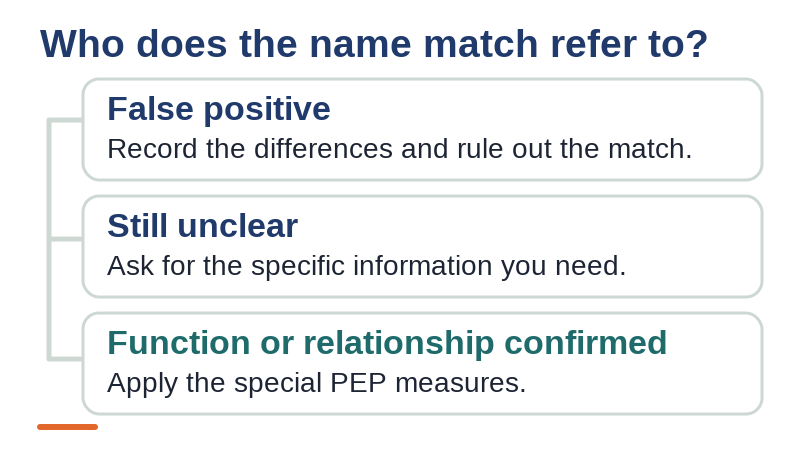
| What do your sources show? | Next steps |
|---|---|
| The potential match relates to someone else. | Record the differences you can substantiate and mark this potential match as resolved. |
| The information is still inconclusive. | Identify the information you still need and request it. If necessary, raise the question internally. |
| Identity and the role or relationship covered by law are both confirmed. | Record which PEP measures apply and who decides whether to enter into or continue the relationship. |
What do you do if you confirm a match?
- Obtain approval from senior management before entering into or continuing the relationship or carrying out the transaction.
- Take appropriate measures to establish the source of wealth and the source of funds used.
- Carry out enhanced ongoing monitoring of the business relationship. Tailor the monitoring to the person and the circumstances.
These measures form part of enhanced due diligence. PEP status alone does not require you to reject a customer.
How do you rule out a namesake?
What changes when someone takes or leaves office?
If you learn during the relationship that the customer or UBO is or has become a PEP, apply the additional measures without delay and update your ongoing monitoring.
How long do you monitor a former PEP?
See also what to record when someone’s PEP status changes.
What else do you assess alongside a PEP check?
Carry out the sanctions check separately. Assess a completed or intended transaction against the reporting indicators. A PEP match on its own does not establish criminal conduct.
The EU Anti-Money Laundering Regulation (AMLR) applies to PEP checks from 10 July 2027. Review the definitions, measures and procedures again before that date.
Sources
- Article 8(6) to (10) of the Wwft — Dutch legislature, text of the Act as at 1 July 2026.
- Article 2 of the Wwft Implementation Decree 2018 (Uitvoeringsbesluit Wwft 2018) — Dutch rule-making authority, text of the Decree as at 30 April 2026.
- DNB Wwft Q&As and Good Practices, section on politically exposed persons — DNB, 8 May 2024.
- Sector-specific Wwft guidance, section on measures for PEPs — BFT, 24 October 2024.
- Obligation to report unusual transactions — FIU-Nederland, the Dutch financial intelligence unit, accessed 21 November 2026.
- Regulation (EU) 2024/1624 — European Parliament and Council, 31 May 2024.
Review planned before 10 July 2027
The AMLR generally applies from 10 July 2027. The editors will review this page again before that date. Until then, it describes the law as at the reference date. Find out what will change for your organisation.
For general information only. This does not constitute legal advice. Consult the current regulations or a qualified adviser about your situation. Spotted an error? Let the editors know.
Customer Diligence is a knowledge base on the Wwft, powered by RiskResolve. It does not provide legal advice.
About · Editorial team and methods · Contact · Privacy · Terms of use · RiskResolve software · UK rules · About this translation
Sources for every article